We'd like to hear from you.
Phone line
Mon to Fri 8:00am-4:00pm
Working hours
451 Atkinson Dr
Honolulu, HI 96814
Honolulu, HI 96814
Visit us
News
ILWU Member Makai Freitas Elected Chair of Hawaiʻi Democratic Party
September 6, 2026
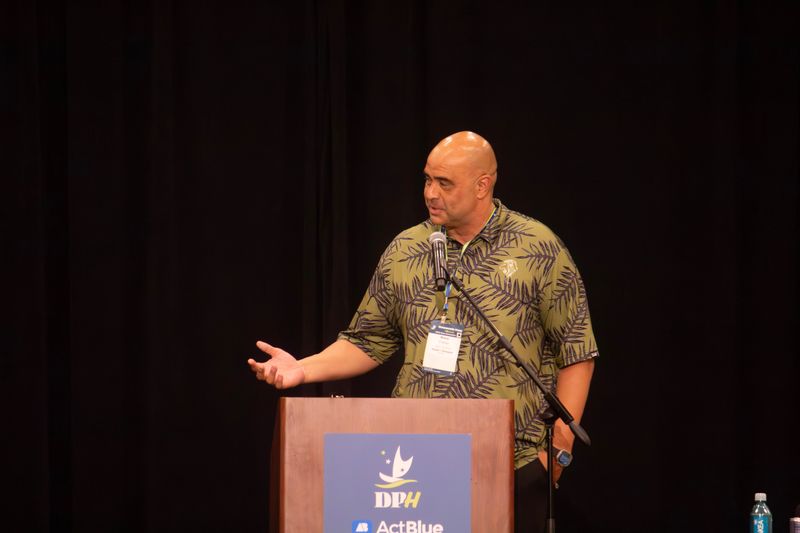
Nearly 200 ILWU members showed up to the Hawaiʻi Democratic Party Convention.
They came from every island and from nearly every industry represented by the union—Longshore, Tourism, Pineapple, and General Trades. They came as delegates for the party’s biennial convention, where issues are discussed, direction is set, and party leaders are elected.
This year, when the votes were counted, Local 142 members had helped elect one of their own. ILWU member Makai Freitas, of the Hawaiʻi Longshore Division, was chosen to serve as the new Chair of the Democratic Party of Hawaiʻi.
For Freitas, however, the moment was less about his election than what it represented. Looking across the convention floor, he saw nearly 200 fellow Local 142 members who had stepped into the political arena—union brothers and sisters willing to organize and fight for a vision of Hawaiʻi rooted in the needs of working people.
“It really hit me what this all meant. It wasn’t about me. It’s about us. It wasn’t about my way, it’s about our way— ILWU leadership and members organizing and taking bold action so we can have a stronger impact for positive change in our families and in our communities.”
That sense of collective purpose is deeply rooted in the ILWU’s history. The union helped build the modern Democratic Party in Hawaiʻi. Following a decade of major strikes in the 1940s and early 1950s, workers understood that many of the issues affecting their lives could not be solved through collective bargaining alone. The fight for better wages, healthcare, housing, and economic opportunity required political action. That understanding helped fuel the Democratic Revolution of 1954 and reshape Hawaiʻi’s political landscape. Today, working people face many of the same fundamental challenges. Families continue to struggle with housing costs, healthcare expenses, and the rising cost of living. Yet the forces driving those challenges have grown larger and more powerful. Corporate power is increasingly concentrated. Wealth continues to flow upward. Rather than the “Big 5” of yesteryear, today’s decisions affecting Hawaiʻi workers are often shaped by multinational corporations, private equity firms, and investment interests operating far beyond the islands.
The mountains are higher and steeper than they were in 1954. For labor, that reality demands more organizing in all arenas.
The ILWU’s political program is core to the union’s efforts to address the conditions facing working families both on and off the job. The union has fought to address Hawaiʻi’s housing crisis through support for Maui’s Bill 9 and other efforts aimed at returning housing to local families. In recent years, the union supported legislation providing free school meals for Hawaiʻi’s students, advocated for increases to the minimum wage, and backed Act 11 to reduce the influence of corporate money in elections and strengthen the voice of ordinary people in the political process.
The union has also worked to protect jobs and industries that sustain local communities. Legislative efforts supporting Hawaiʻi agriculture have benefited sectors such as pineapple and macadamia nuts, while initiatives in tourism have sought to strengthen worker protections and industry accountability. This year, the union invested significant effort in legislation requiring advance notification of labor disruptions in the visitor industry. While the measure ultimately fell short, the campaign underscored the importance of continuing to build labor’s political strength and influence.
Freitas sees that work as a continuation of a long tradition within the union. “We know that we have to go beyond c o l l e c t i v e bargaining. The political realm is where we take the fights for better wages and healthcare and move them from an issue of contracts to an issue of law that benefits all working people in Hawaiʻi.”